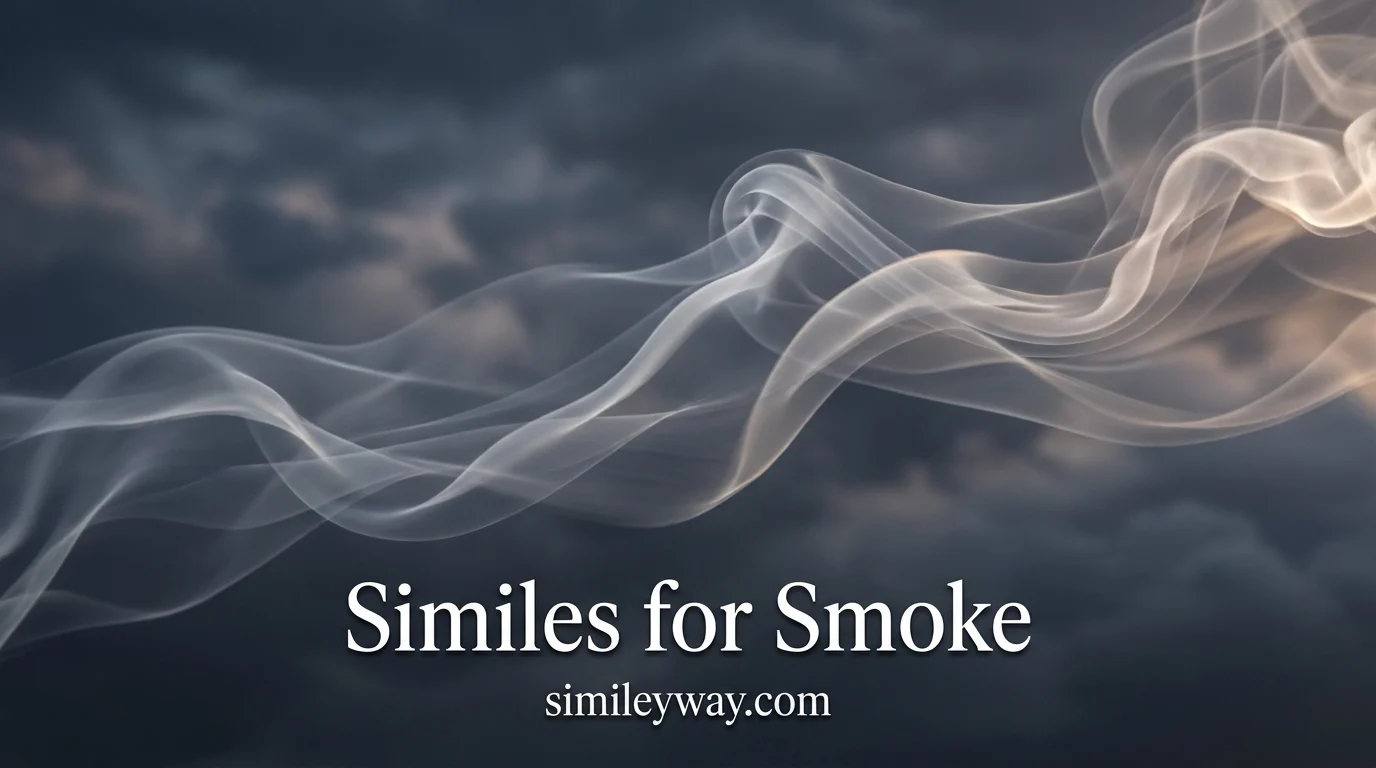
Smoke is one of those things that can change the look of a place in seconds. It can rise slowly, twist through the air, cover the sky, or disappear without a trace. But how can you describe it in a way that helps readers picture it clearly? This is where similes for smoke can make your writing more interesting.
A good simile compares smoke to something familiar, such as a ribbon, cloud, ghost, or snake. These comparisons help readers imagine its color, shape, movement, and thickness. They can also create different feelings, from peaceful and dreamy to dark and frightening.
Whether you are writing a short story, poem, school assignment, or descriptive paragraph, the right comparison can bring your words to life. In this guide, you will discover 20 creative similes for smoke, along with their meanings and example sentences. You will also learn how to use these comparisons in your writing and create your own. Let’s explore how a simple cloud of smoke can inspire beautiful descriptions!
What Are Similes for Smoke?
Similes for smoke are comparisons that describe smoke by connecting it to another object, feeling, or natural thing. They use comparison words such as like or as to help readers imagine what smoke looks like or how it moves.
For example:
“The smoke curled into the sky like a dancing ribbon.”
This sentence compares moving smoke to a ribbon. It helps readers imagine smoke twisting and flowing gently through the air.
Similes are a type of figurative language. They make ordinary descriptions more colorful, clear, and memorable.
20 Similes for Smoke With Meanings and Examples
Here are 20 creative comparisons that can help you describe smoke in everyday language, stories, poems, and other forms of writing.
1. Smoke Like a Gray Ribbon
Meaning: Smoke that moves through the air in a long, thin, flowing shape.
Explanation: This simile compares smoke to a ribbon because both can twist, bend, and move gently. It creates a soft and beautiful picture.
Example Sentences:
- The smoke floated above the chimney like a gray ribbon in the morning breeze.
- A thin line of smoke stretched across the sky like a ribbon waving in the wind.
2. Smoke Like a Ghost
Meaning: Smoke that moves silently and seems to appear and disappear.
Explanation: This comparison makes smoke seem mysterious and almost unreal. It is useful when describing smoke drifting through a dark or quiet place.
Example Sentences:
- Smoke crept through the empty hallway like a ghost searching for a home.
- The white smoke floated between the trees like a ghost in the night.
3. Smoke Like a Soft Blanket
Meaning: Smoke that spreads over an area and covers everything beneath it.
Explanation: A blanket covers a bed, while thick smoke can cover buildings, trees, and roads. This simile helps readers imagine a wide layer of smoke.
Example Sentences:
- Thick smoke covered the village like a soft blanket on a cold morning.
- A layer of smoke settled over the field like a blanket hiding the grass.
4. Smoke Like Ink Spreading in Water
Meaning: Smoke that spreads outward and slowly fills the surrounding space.
Explanation: This simile compares the spreading movement of smoke to ink moving through water. It creates a clear picture of smoke expanding in different directions.
Example Sentences:
- Black smoke spread across the air like ink spreading in water.
- The smoke from the fire twisted outward like dark ink in a glass of water.
5. Smoke Like a Dancing Veil
Meaning: Smoke that moves lightly and gracefully through the air.
Explanation: A veil is a thin piece of cloth that can float and move with the wind. This comparison makes smoke appear delicate and graceful.
Example Sentences:
- The smoke rose from the candle like a dancing veil in the sunlight.
- A gentle breeze moved the smoke like a veil floating across a stage.
6. Smoke Like a Coiling Snake
Meaning: Smoke that twists and curls as it rises.
Explanation: A snake moves by bending and twisting its body. Similarly, smoke can form winding shapes as it travels through the air.
Example Sentences:
- The smoke curled around the tree branches like a coiling snake.
- Dark smoke twisted above the burning wood like a snake climbing toward the clouds.
7. Smoke Like a Fading Cloud
Meaning: Smoke that becomes thinner and slowly disappears.
Explanation: Clouds can change shape and fade from view. This simile describes smoke that gradually loses its shape as it spreads into the air.
Example Sentences:
- The smoke disappeared into the blue sky like a fading cloud.
- A small trail of smoke drifted away like a cloud melting into the distance.
8. Smoke Like a Curtain
Meaning: Smoke that forms a thick layer and hides what is behind it.
Explanation: A curtain blocks the view of something behind it. In the same way, smoke can hide objects, buildings, and even entire landscapes.
Example Sentences:
- Smoke covered the road like a curtain hiding the distant hills.
- A thick cloud of smoke hung in the air like a curtain across the burning forest.
9. Smoke Like a Feather Floating in the Air
Meaning: Smoke that rises gently and moves with almost no effort.
Explanation: A feather is light and easily carried by the wind. This comparison describes thin smoke that drifts slowly and peacefully.
Example Sentences:
- The smoke from the candle floated upward like a feather in the breeze.
- A tiny stream of smoke moved across the room like a feather carried by the wind.
10. Smoke Like a Dark Storm Cloud
Meaning: Smoke that looks large, dark, and threatening.
Explanation: Storm clouds often make the sky look gloomy. Comparing smoke to a dark storm cloud creates a sense of danger or fear.
Example Sentences:
- Dark smoke rose above the burning building like a storm cloud ready to cover the city.
- A huge cloud of black smoke gathered over the factory like a storm cloud.
11. Smoke Like a Whisper in the Wind
Meaning: Smoke that moves quietly and gently through the air.
Explanation: A whisper is soft and difficult to hear. This simile gives smoke a peaceful and delicate feeling as it drifts away.
Example Sentences:
- The last trail of smoke disappeared like a whisper in the wind.
- Smoke slipped through the open window like a whisper moving across the room.
12. Smoke Like a Flowing River
Meaning: Smoke that moves continuously in one direction.
Explanation: A river flows across the land without stopping. This comparison helps readers imagine a long stream of smoke moving through the air.
Example Sentences:
- Smoke flowed across the valley like a river moving through the mountains.
- The wind pushed the smoke over the fields like a river of gray mist.
13. Smoke Like a White Silk Scarf
Meaning: Thin, pale smoke that moves smoothly and gracefully.
Explanation: Silk is soft, light, and delicate. This simile makes smoke seem beautiful and gentle as it twists through the air.
Example Sentences:
- White smoke rose from the incense like a silk scarf floating above the table.
- The chimney released a thin stream of smoke like a white scarf dancing in the breeze.
14. Smoke Like a Hungry Monster
Meaning: Thick smoke that spreads quickly and appears frightening.
Explanation: This comparison gives smoke a scary and powerful appearance. It works especially well in stories about fires, danger, or mysterious places.
Example Sentences:
- Smoke swallowed the empty street like a hungry monster.
- A dark cloud of smoke rushed toward the houses like a monster chasing everything in its path.
15. Smoke Like a Spiral Staircase
Meaning: Smoke that rises in a twisting, circular pattern.
Explanation: A spiral staircase moves upward in a curved shape. This simile helps readers picture smoke turning and climbing as it rises.
Example Sentences:
- The smoke climbed into the sky like a spiral staircase.
- Small circles of smoke rose from the fire like steps on a winding staircase.
16. Smoke Like a Gray Ocean Wave
Meaning: Smoke that rolls and spreads in large, moving shapes.
Explanation: Ocean waves rise, roll, and move across the water. This comparison describes thick smoke that seems to move in waves.
Example Sentences:
- Gray smoke rolled across the open field like an ocean wave.
- The smoke rose above the burning forest like a giant wave moving toward the shore.
17. Smoke Like a Shifting Shadow
Meaning: Smoke that changes shape and moves from one place to another.
Explanation: Shadows change their appearance as light and objects move. Similarly, smoke constantly changes its shape as the wind carries it.
Example Sentences:
- Smoke moved between the trees like a shifting shadow.
- The dark smoke crossed the wall like a shadow dancing in the moonlight.
18. Smoke Like a Magic Spell
Meaning: Smoke that creates a mysterious, dreamy, or magical appearance.
Explanation: This comparison makes smoke seem as if it has magical powers. It is especially useful in fantasy stories and imaginative poems.
Example Sentences:
- Colorful smoke filled the stage like a magic spell.
- The incense smoke curled around the candles like a spell from an old fairy tale.
19. Smoke Like a Giant Gray Wall
Meaning: Thick smoke that blocks the view and makes it difficult to see beyond it.
Explanation: A wall is solid and blocks the view of what lies behind it. This comparison helps readers understand how dense smoke can hide an entire area.
Example Sentences:
- A giant cloud of smoke stood over the highway like a gray wall.
- Thick smoke surrounded the house like a wall hiding it from the outside world.
20. Smoke Like a Dream Slipping Away
Meaning: Smoke that slowly fades and disappears into the distance.
Explanation: Dreams can feel real for a moment but disappear when we wake up. This simile gives smoke a gentle, emotional, and temporary quality.
Example Sentences:
- The final trail of smoke vanished into the morning sky like a dream slipping away.
- Her breath of smoke disappeared above the candle like a dream fading at sunrise.
How to Use Similes for Smoke in Creative Writing
Similes can make descriptions of smoke more powerful and interesting. Instead of simply saying that smoke is rising, you can compare it to something readers already know.
Here are some ways to use these comparisons in different types of writing.
1. In Stories and Fiction
Stories need clear descriptions to help readers imagine the setting and events.
For example:
“The old chimney released smoke like a gray ghost drifting above the forgotten house.”
This sentence creates a mysterious feeling and helps readers picture an old, quiet place.
You can use different smoke comparisons to create feelings of peace, danger, mystery, or excitement.
2. In Poems
Poetry often uses beautiful images and creative language. Similes can help you describe smoke in a more emotional way.
For example:
“Smoke danced like a silver ribbon, slowly disappearing into the evening sky.”
This comparison creates a gentle image that works well in descriptive poetry.
3. In School Assignments
Students can use similes to make descriptive paragraphs more interesting.
Instead of writing:
“The smoke was thick and dark.”
Try writing:
“The smoke rose like a dark storm cloud above the burning wood.”
The second sentence gives readers a much clearer picture.
4. In Descriptive Paragraphs
When describing a place, smoke can help create a strong picture of the surroundings.
For example:
“Thin smoke floated above the village like white silk scarves. It moved gently between the houses before disappearing into the morning air.”
This description helps readers imagine the movement, color, and atmosphere.
5. In Everyday Conversations
You do not need to write a poem or story to use similes. They can also make everyday conversations more expressive.
For example:
- “The smoke was spreading like ink in water.”
- “The smoke curled like a snake above the fire.”
- “A blanket of smoke covered the whole street.”
These simple comparisons make your meaning easier to picture.
How to Create Your Own Similes for Smoke
Creating your own similes is easier than you might think. You only need to notice how smoke looks or moves and compare it with something familiar.
Follow these five simple steps.
Step 1: Choose What You Want to Describe
First, decide which quality of smoke you want to explain.
Think about:
- Its color: white, gray, or black.
- Its movement: rising, twisting, or drifting.
- Its shape: thin, thick, or spreading.
- Its appearance: soft, dark, or mysterious.
For example, you may want to describe smoke that rises slowly.
Step 2: Think of Something With a Similar Quality
Now choose an object or thing that has a similar appearance or movement.
For example:
- A feather is light.
- A ribbon twists.
- A snake curls.
- A cloud spreads across the sky.
These objects can help you build creative comparisons.
Step 3: Connect the Two Ideas Using Like or As
Use comparison words to connect smoke with your chosen object.
For example:
- Smoke floated like a feather.
- Smoke twisted like a snake.
- Smoke spread like a cloud.
The words like and as help turn these comparisons into similes.
Step 4: Make the Comparison Clear and Meaningful
Your comparison should help readers understand what you mean.
For example:
“The smoke moved like a dancing ribbon.”
This works because both smoke and ribbons can move and twist in the air.
Avoid comparisons that have no clear connection.
Step 5: Read Your Sentence Aloud and Improve It
Read your simile slowly. Ask yourself:
- Does it sound natural?
- Can readers picture the smoke?
- Does it match the feeling I want to create?
- Is the comparison easy to understand?
If the sentence sounds awkward, try a different comparison.
A Few Original Examples:
- The smoke rose like a silver staircase reaching toward the clouds.
- Gray smoke drifted like a sleepy cloud across the quiet village.
- The smoke twisted like a dancer moving across an empty stage.
Keep practicing, and soon you will be able to create your own interesting comparisons.
Practical Exercise: Test Your Understanding
Now it is time to test what you have learned. Try these 10 beginner-friendly questions about smoke similes.
Questions
1. Identify the Simile
Which sentence contains a simile?
A. Smoke rose above the house.
B. Smoke curled like a snake.
C. The fire burned brightly.
2. Complete the Missing Comparison
“The smoke floated through the air like a ______.”
A. Feather
B. Stone
C. Brick
3. Choose the Correct Meaning
What does “smoke spread like ink in water” mean?
A. Smoke became hard.
B. Smoke spread outward through the air.
C. Smoke disappeared immediately.
4. Identify the Comparison Words
Find the comparison word in this sentence:
“The smoke moved like a dancing ribbon.”
5. Choose the Best Simile
Which simile best describes thick, dark, and frightening smoke?
A. Smoke like a soft feather.
B. Smoke like a dark storm cloud.
C. Smoke like a tiny flower.
6. Correct the Incorrect Simile
Improve this sentence by making the comparison clearer:
“The smoke was like a happy sandwich.”
Write a more suitable comparison.
7. Identify the Simile
Is this sentence a simile?
“The smoke looked like a gray ocean wave.”
Answer yes or no and explain your choice.
8. Complete the Sentence
“White smoke rose from the candle like a ______.”
Create a suitable comparison using your imagination.
9. Choose the Correct Meaning
What does “smoke like a shifting shadow” describe?
A. Smoke that stays in one place.
B. Smoke that changes shape and moves.
C. Smoke that turns into water.
10. Create Your Own Simile
Write one original simile to describe smoke rising into the sky. Use either “like” or “as.”
Answers and Explanations
1. Correct Answer: B. Smoke curled like a snake.
This is a simile because it compares smoke to a snake using the word “like.”
2. Correct Answer: A. Feather.
A feather is light and moves easily through the air. It is a suitable comparison for gentle, floating smoke.
3. Correct Answer: B. Smoke spread outward through the air.
Ink spreads through water in different directions. This comparison describes the way smoke expands and fills the surrounding space.
4. Correct Answer: Like.
The word “like” connects the smoke with a dancing ribbon. It makes the comparison a simile.
5. Correct Answer: B. Smoke like a dark storm cloud.
Dark storm clouds often create a gloomy and threatening feeling. This makes them a good comparison for thick, dark smoke.
6. Sample Correct Answer: The smoke floated like a gray cloud.
A cloud and smoke can both float and spread through the air. This creates a clearer and more natural comparison.
7. Correct Answer: Yes.
The sentence compares smoke to an ocean wave using the word “like.” Both can form large, flowing shapes.
8. Sample Correct Answer: White smoke rose from the candle like a silk ribbon.
A silk ribbon is light and graceful. It helps describe the gentle movement of thin smoke.
9. Correct Answer: B. Smoke that changes shape and moves.
A shifting shadow changes its appearance and position. The simile describes smoke that moves and changes shape.
10. Sample Correct Answer: The smoke rose like a silver staircase reaching toward the clouds.
This is a simile because it uses “like” to compare rising smoke to a staircase. The comparison creates a clear picture of smoke moving upward.
Frequently Asked Questions (FAQs)
1. What Is a Good Simile for Smoke?
A good simile for smoke is “smoke curled like a snake.” It describes the twisting movement of smoke in a simple and memorable way.
2. How Do You Describe Smoke in Creative Writing?
You can describe smoke by focusing on its color, shape, movement, and thickness. Compare it to familiar things such as clouds, ribbons, waves, or shadows to create vivid images.
3. What Is a Simile for Thick Smoke?
“Thick smoke spread like a giant gray wall” is a useful simile. It shows how dense smoke can cover an area and block the view.
4. What Is a Simile for White Smoke?
“White smoke floated like a soft silk scarf” is a beautiful comparison. It describes thin, pale smoke moving gently through the air.
5. What Is a Simile for Smoke Rising Into the Sky?
“Smoke rose like a spiral staircase reaching toward the clouds” describes smoke moving upward in a twisting shape.
6. Can Smoke Be Compared to a Cloud?
Yes! Smoke can be compared to a cloud because both can spread, change shape, and float through the air. For example, “The smoke drifted like a gray cloud above the trees.”
7. Why Do Writers Use Similes to Describe Smoke?
Writers use similes to help readers picture smoke more clearly. These comparisons can also create different moods, such as mystery, fear, peace, or beauty.
Conclusion
Similes make ordinary descriptions more colorful and meaningful. With these 20 similes for smoke, you can describe its movement, shape, color, and appearance in creative ways. Whether smoke rises like a ribbon, spreads like a cloud, or twists like a snake, each comparison helps readers imagine the scene more clearly. You can use these examples in stories, poems, school assignments, and everyday conversations. Remember, creating a good simile does not require difficult words. Simply notice something about smoke, find another thing with a similar quality, and connect them using “like” or “as.” Keep practicing, explore new comparisons, and let your imagination make every description more interesting!

Hi, I’m Oscar Spencer. I manage SimileWay and ensure our similes, metaphors, and idioms content is accurate, engaging, and easy to understand, helping readers improve their language and communication skills every day.






1 thought on “20 Creative Similes for Smoke: Meanings and Examples to Make Your Writing Vivid”