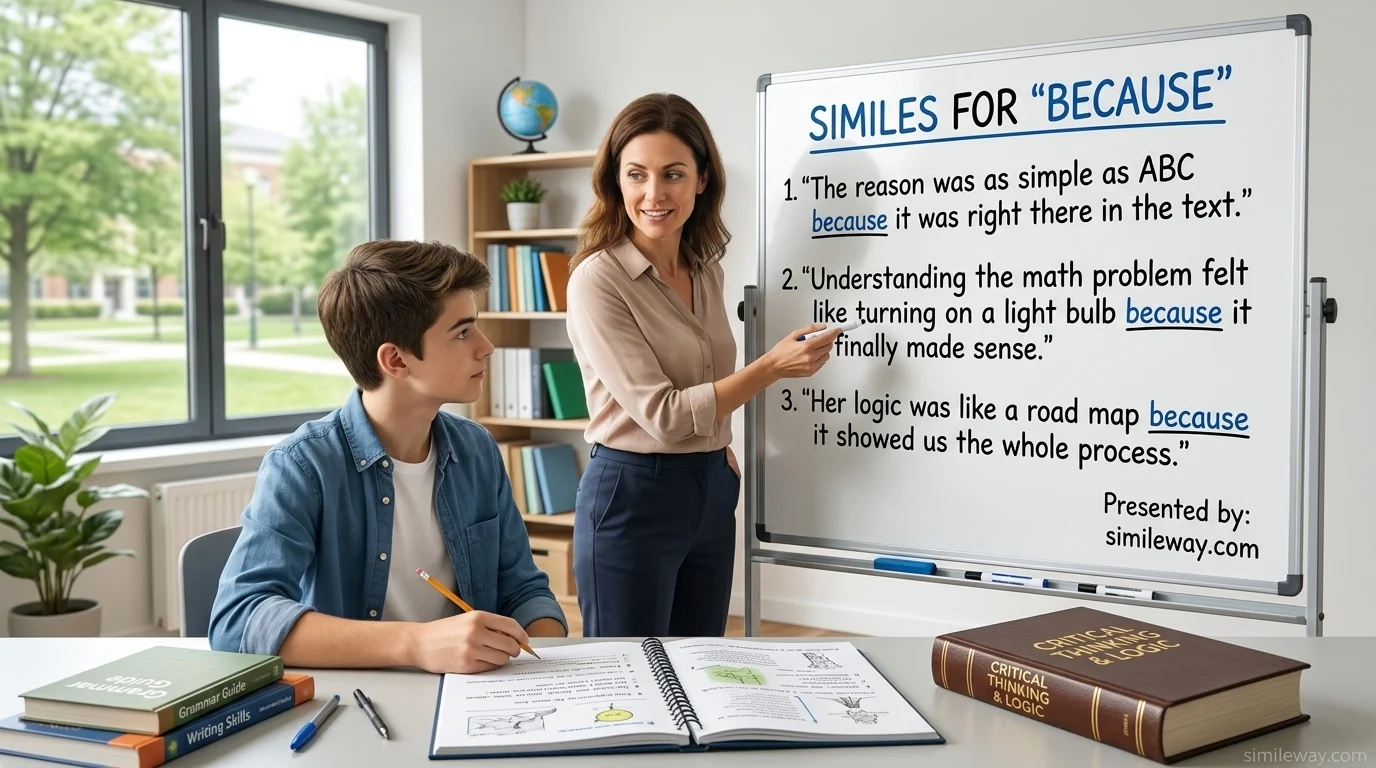
Have you ever wanted to explain why something happened but felt that the word “because” sounded too plain? That is where creative writing can help. A simile compares one thing to another, usually with words such as like or as. While “because” itself is not something we normally compare directly, you can create simile sentences that express reasons, causes, or explanations in a vivid way.
For example, instead of simply saying, “She smiled because she was happy,” you might say, “She smiled like sunshine breaking through clouds because she had finally heard good news.”
In simple terms, similes help ordinary ideas feel more colorful. They give readers a picture they can see, feel, or imagine. If you are learning how to use similes in writing, these examples will help you connect causes and reasons with creative comparisons.
Let’s explore some useful similes for because and see how they work in real sentences.
20 Similes for Because
1. Because like a spark starting a fire
Meaning: This comparison shows that a reason can start something important.
Explanation: A small spark can create a large fire, just as a small reason can lead to a major action.
Example sentences:
- He joined the team because, like a spark starting a fire, his friend encouraged him.
- Her idea spread quickly because it was like a spark starting a fire.
2. Because like a key opening a door
Meaning: A reason can explain or unlock an idea.
Explanation: Just as a key opens a locked door, an explanation helps someone understand why something happened.
Example sentences:
- His honest answer was like a key opening a door because it explained the problem.
- She gave a reason like a key opening a door, and everything became clear.
3. Because like a bridge connecting two ideas
Meaning: A reason can connect an action with its cause.
Explanation: A bridge joins two places, while a good explanation joins two thoughts.
Example sentences:
- Her explanation worked like a bridge connecting two ideas.
- The word “because” is like a bridge connecting an action to its reason.
4. Because like a thread tying a story together
Meaning: A reason can help different parts of a story make sense.
Explanation: A thread can hold pieces together, just as reasons can connect events in writing.
Example sentences:
- The character’s fear was like a thread tying the whole story together.
- His reason worked like a thread tying every event together.
5. Because like a light in the dark
Meaning: An explanation can make something easier to understand.
Explanation: Light helps us see clearly, while a reason can remove confusion.
Example sentences:
- Her answer was like a light in the dark because it explained what happened.
- The teacher’s explanation felt like a light in the dark.
6. Because like a map showing the way
Meaning: A reason can guide someone toward understanding.
Explanation: A map tells you where to go, while an explanation shows why something happened.
Example sentences:
- His explanation was like a map showing the way.
- The reason behind her decision was like a map showing us how she reached it.
7. Because like a puzzle piece fitting into place
Meaning: A reason can make a confusing situation clear.
Explanation: A missing puzzle piece completes part of a picture, just as a reason can complete an idea.
Example sentences:
- Her final explanation was like a puzzle piece fitting into place.
- The missing fact felt like a puzzle piece fitting into place.
8. Because like an anchor holding a ship
Meaning: A reason can provide support for an idea or action.
Explanation: An anchor keeps a ship steady, while a strong reason supports a statement.
Example sentences:
- His evidence was like an anchor holding a ship.
- Her reason acted like an anchor holding her argument steady.
9. Because like roots holding a tree
Meaning: A reason can be the hidden foundation behind an action.
Explanation: Roots support a tree beneath the ground, just as a cause can support an action beneath the surface.
Example sentences:
- Her kindness had a deeper reason, like roots holding a tree.
- His decision had hidden causes like roots holding a tree firmly.
10. Because like a window revealing the view
Meaning: An explanation can reveal information that was not obvious before.
Explanation: A window lets us see what is outside, while a reason lets us see what is behind an event.
Example sentences:
- His explanation was like a window revealing the view.
- The reason behind her choice opened like a window revealing the view.
11. Because like a seed growing into a flower
Meaning: A small cause can eventually produce a noticeable result.
Explanation: A seed begins small but can grow into something beautiful, just as a simple reason can lead to a major result.
Example sentences:
- Her early encouragement was like a seed growing into a flower.
- That small decision was like a seed growing into a flower over time.
12. Because like a clock showing time
Meaning: A clear reason helps explain when or why something happens.
Explanation: A clock gives us useful information, while an explanation gives us useful context.
Example sentences:
- His explanation was like a clock showing time.
- The details worked like a clock showing when everything changed.
13. Because like a candle guiding a traveler
Meaning: A reason can guide someone through uncertainty.
Explanation: A candle provides light, helping someone move forward when the path is unclear.
Example sentences:
- Her advice was like a candle guiding a traveler.
- The reason behind his choice became like a candle guiding us through the confusion.
14. Because like a compass pointing north
Meaning: A reason can provide direction.
Explanation: A compass helps travelers find their direction, while a clear reason helps people understand a decision.
Example sentences:
- His main goal was like a compass pointing north.
- The explanation acted like a compass pointing us toward the truth.
15. Because like glue holding pieces together
Meaning: A reason can keep different parts of an explanation connected.
Explanation: Glue holds separate pieces together, just as a strong reason can connect different ideas.
Example sentences:
- The main reason was like glue holding the argument together.
- Her explanation worked like glue holding all the facts together.
16. Because like a drumbeat driving a song
Meaning: A reason can motivate an action.
Explanation: A drumbeat gives rhythm and energy to music, while a strong reason can give energy and purpose to a decision.
Example sentences:
- His dream was like a drumbeat driving his actions.
- Her desire to help others was like a drumbeat driving her forward.
17. Because like rain feeding a garden
Meaning: A cause can help something develop or grow.
Explanation: Rain gives plants what they need to grow, just as a good reason can support progress.
Example sentences:
- Her encouragement was like rain feeding a garden.
- His support was like rain feeding a garden of new ideas.
18. Because like a foundation beneath a house
Meaning: A reason can provide a strong base for an action or belief.
Explanation: A house needs a foundation, and an argument or decision often needs a clear reason.
Example sentences:
- Her experience was like a foundation beneath a house.
- His reason became the foundation beneath his decision.
19. Because like a mirror showing the truth
Meaning: An explanation can reveal the truth behind something.
Explanation: A mirror reflects what is in front of it, while a clear reason can reveal what is really happening.
Example sentences:
- His honest answer was like a mirror showing the truth.
- The explanation became like a mirror showing the truth behind her actions.
20. Because like a doorway into understanding
Meaning: A reason can help someone understand an idea more deeply.
Explanation: A doorway gives access to another place, while an explanation gives access to better understanding.
Example sentences:
- Asking “why” is like finding a doorway into understanding.
- Her explanation was like a doorway into understanding the character.
How to Use Similes for Because in Writing
When you use creative writing similes, remember that “because” is usually a linking word, not a direct object of comparison. So, rather than forcing a comparison with the word itself, compare the reason, cause, explanation, or result to something familiar.
For example:
Simple:
“She stayed home because she was sick.”
More creative:
“Her illness was like a heavy cloud, so she stayed home.”
The second sentence gives the reader a stronger image. It does not simply tell the reader the reason; it helps them imagine it.
You might say that the best simile sentences make an ordinary idea easier to picture.
Practical Exercise: Test Your Simile Skills
Try these questions before looking at the answers.
Questions
1. Complete the simile:
“His explanation was like a ______ because it made everything clear.”
2. Which sentence contains a simile?
A. She left because she was tired.
B. Her tiredness was like a heavy blanket.
C. She was very tired.
3. Complete the sentence:
“The reason was like a key ______.”
4. What does this simile suggest?
“Her explanation was like a light in the dark.”
5. Create a simile for a strong reason using “like.”
6. Which image best represents a reason that gives direction?
A. Compass
B. Pillow
C. Spoon
7. Complete the sentence:
“His decision was like a tree because its reason was ______.”
8. Find the simile:
“The evidence was strong, and it supported his argument like an anchor holding a ship.”
9. Rewrite this sentence with a simile:
“She explained the problem clearly.”
10. Write your own simile comparing an explanation to something that helps people understand.
Answers and Explanations
1. Answer: “key”
Explanation: A key opens a door, just as an explanation can unlock understanding.
2. Answer: B
Explanation: “Her tiredness was like a heavy blanket” uses like to make a comparison.
3. Answer: “opening a door”
Explanation: This shows that the reason helps reveal or explain something.
4. Answer: It suggests that the explanation removes confusion.
Explanation: Light helps us see in darkness, so the comparison makes understanding feel clearer.
5. Sample answer: “His honesty was like a strong bridge supporting his reason.”
Explanation: The bridge represents support and connection.
6. Answer: A, compass
Explanation: A compass gives direction, making it a useful comparison for guidance.
7. Answer: “deeply rooted”
Explanation: Tree roots represent a strong foundation or hidden cause.
8. Answer: “like an anchor holding a ship”
Explanation: This is the simile because it compares the evidence to an anchor.
9. Sample answer: “Her explanation was like a clear window showing the view.”
Explanation: The window represents clarity and visibility.
10. Sample answer: “Her explanation was like a map showing the way.”
Explanation: A map helps people find their way, just as an explanation helps people understand.
Conclusion
Similes make writing easier to picture, more interesting, and more memorable. Even when you are writing about simple ideas such as reasons, causes, or explanations, a creative comparison can give your words more life.
The key is not to force a simile. Think about the idea you want to explain and ask yourself what familiar object, action, or image feels similar. A reason might be like a key, a bridge, a compass, or a light.
As you practice how to use similes in writing, you will become better at creating original comparisons. Start with simple ideas, experiment with different images, and do not worry about getting every simile perfect. Your goal is to help the reader see your idea in a fresh way.

Hi, I’m Oscar Spencer. I manage SimileWay and ensure our similes, metaphors, and idioms content is accurate, engaging, and easy to understand, helping readers improve their language and communication skills every day.