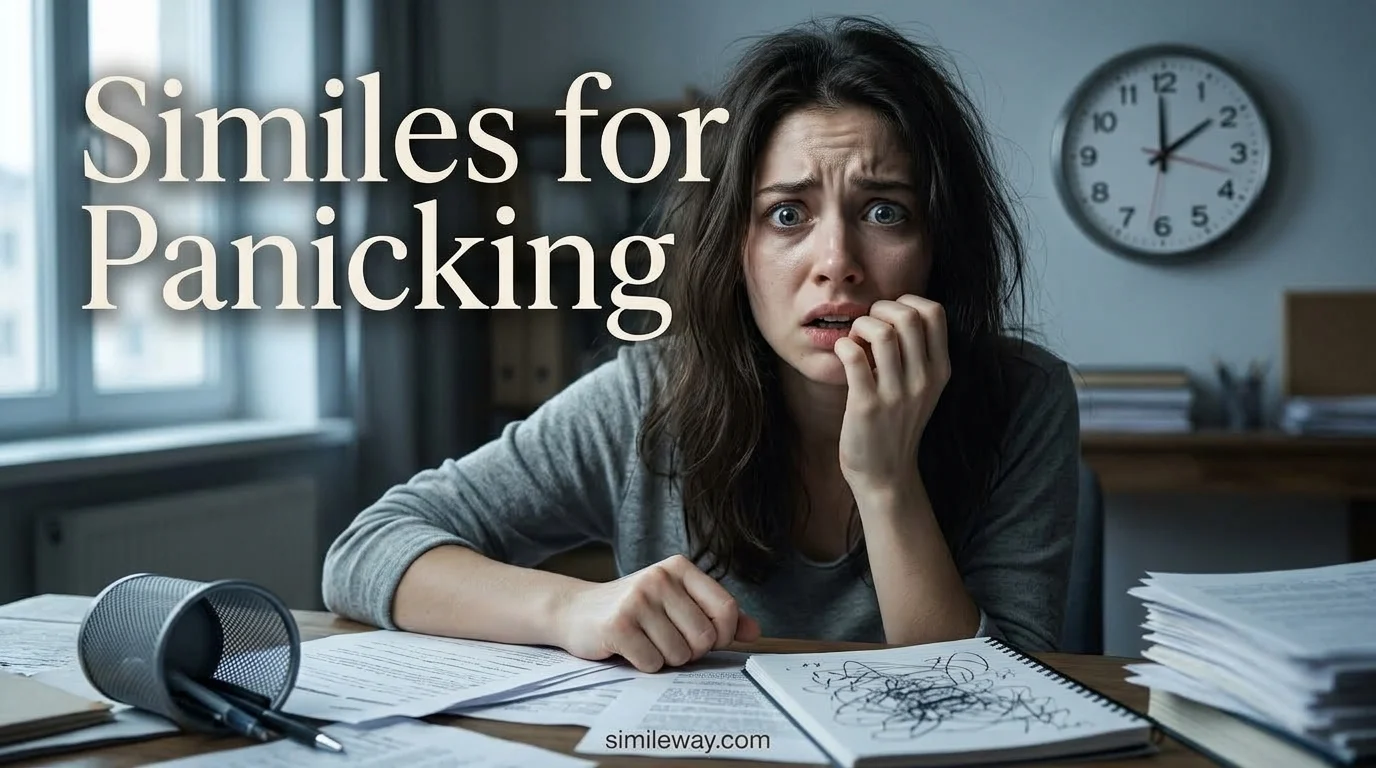
Have you ever felt so nervous that your heart seemed to race ahead of you? Maybe your hands shook, your thoughts became messy, and you could not decide what to do next. When ordinary words are not enough to describe that feeling, similes for panicking can make your writing much more vivid.
A simile compares one thing to another using words such as “like” or “as.” For example, instead of saying, “She was panicking,” you might say, “She was shaking like a leaf in a storm.” The comparison helps the reader feel the fear rather than simply being told about it.
In simple terms, similes turn emotions into pictures. They can make a story, poem, essay, or character description much more powerful. Let’s explore 20 creative writing similes that can help you describe panic, fear, nervousness, and confusion in a natural way.
20 Similes for Panicking
1. Panicking like a cat in a room full of dogs
Meaning: Feeling extremely frightened and desperate to escape.
This simile creates a strong image of someone who feels trapped and unsafe.
Example sentences:
- He was panicking like a cat in a room full of dogs when the alarm went off.
- She ran around like a cat in a room full of dogs, looking for a way out.
2. Shaking like a leaf in the wind
Meaning: Trembling badly because of fear or nervousness.
This is one of the most familiar examples of similes for fear.
Example sentences:
- I was shaking like a leaf in the wind before the interview.
- She stood at the door, shaking like a leaf in the wind.
3. Panicking like a deer caught in headlights
Meaning: Becoming frozen, frightened, or confused by a sudden danger.
It suggests that fear has made someone unable to think clearly.
Example sentences:
- He looked like a deer caught in headlights when the teacher called his name.
- I stood there like a deer caught in headlights after hearing the news.
4. Running around like a chicken with its head cut off
Meaning: Acting wildly and without a clear plan.
This humorous simile works well when someone is panicking and making confused movements.
Example sentences:
- Everyone was running around like chickens with their heads cut off before the event.
- She was panicking like a chicken with its head cut off when she lost her keys.
5. Heart pounding like a drum
Meaning: Having a very fast and strong heartbeat because of fear or excitement.
This simile helps readers imagine the physical effect of panic.
Example sentences:
- My heart was pounding like a drum as I waited for the results.
- His heart pounded like a drum when he heard footsteps behind him.
6. Mind racing like a speeding train
Meaning: Having many thoughts rushing through your mind.
This is useful when panic makes it hard to focus.
Example sentences:
- Her mind was racing like a speeding train after she realized she had made a mistake.
- My mind raced like a speeding train as I searched for an answer.
7. Panicking like a trapped animal
Meaning: Feeling desperate because you believe there is no easy way to escape.
The comparison shows intense fear and helplessness.
Example sentences:
- He was panicking like a trapped animal when the door would not open.
- She looked around like a trapped animal, searching for an escape.
8. Breathing like a runner after a race
Meaning: Breathing very quickly because of fear or panic.
This simile focuses on one of the physical signs of panic.
Example sentences:
- He was breathing like a runner after a race as the danger approached.
- She sat on the floor, breathing like a runner after a race.
9. Nervous as a bird in a storm
Meaning: Feeling extremely uneasy and frightened.
A bird caught in a storm gives the reader an image of vulnerability and fear.
Example sentences:
- I was as nervous as a bird in a storm before going on stage.
- She looked as nervous as a bird in a storm during the emergency.
10. Thoughts spinning like a broken wheel
Meaning: Being unable to organize your thoughts.
This works especially well for describing mental confusion during panic.
Example sentences:
- His thoughts were spinning like a broken wheel after the accident.
- My thoughts spun like a broken wheel when everyone started shouting.
11. Panicking like a sailor in a sinking boat
Meaning: Feeling desperate because you believe a serious problem is getting worse.
This simile creates a dramatic sense of danger.
Example sentences:
- He was panicking like a sailor in a sinking boat when the engine stopped.
- She felt like a sailor in a sinking boat as the storm grew stronger.
12. Eyes wide like a frightened owl
Meaning: Looking shocked, scared, or surprised.
The image of a frightened owl helps show fear through facial expression.
Example sentences:
- Her eyes were wide like a frightened owl when she heard the crash.
- He stared at me with eyes wide like a frightened owl.
13. Trembling like a phone on vibrate
Meaning: Shaking repeatedly and uncontrollably.
This modern comparison can add humor to casual writing.
Example sentences:
- I was trembling like a phone on vibrate before the big announcement.
- His hands were shaking like a phone on vibrate as he opened the letter.
14. Panicking like a mouse near a cat
Meaning: Feeling extremely frightened by an immediate threat.
The comparison is simple and easy for readers of all ages to understand.
Example sentences:
- He was panicking like a mouse near a cat when the dog started barking.
- She looked like a mouse near a cat when the angry crowd moved closer.
15. As restless as a bee in a jar
Meaning: Being unable to sit still because of nervousness.
This simile is useful when panic causes constant movement.
Example sentences:
- He was as restless as a bee in a jar while waiting for the phone call.
- She became as restless as a bee in a jar before the results arrived.
16. Thoughts flying like birds from a tree
Meaning: Having thoughts scattered in many directions.
This comparison shows how panic can make concentration difficult.
Example sentences:
- My thoughts were flying like birds from a tree when the teacher asked the question.
- Her thoughts flew like birds from a tree after she received the message.
17. Sweating like ice melting in the sun
Meaning: Sweating heavily because of nervousness or fear.
The melting ice creates a clear picture of something quickly disappearing.
Example sentences:
- I was sweating like ice melting in the sun before my speech.
- He stood there sweating like ice melting in the sun while everyone watched.
18. Frozen like a statue
Meaning: Becoming unable to move or react because of fear.
This is especially effective for describing sudden panic.
Example sentences:
- She stood frozen like a statue when she heard the scream.
- I was frozen like a statue when the lights suddenly went out.
19. Panicking like a person lost in a maze
Meaning: Feeling confused, helpless, and unsure which way to go.
It works well when panic comes from uncertainty rather than immediate danger.
Example sentences:
- He was panicking like a person lost in a maze after missing the train.
- She felt like a person lost in a maze when she could not find her family.
20. Fear rising like a wave
Meaning: Feeling panic grow stronger and stronger.
This simile shows that fear can build gradually until it feels overwhelming.
Example sentences:
- Her fear rose like a wave when she realized she was alone.
- Panic rose like a wave as the storm moved closer.
How to Use Similes for Panicking in Your Writing
Good similes do more than decorate a sentence. They help readers feel the emotion.
When writing about panic, think about what the person is doing physically and mentally.
You might describe:
- A racing heart
- Shaking hands
- Fast breathing
- Wide eyes
- Sweating
- Scattered thoughts
- Restless movement
- Feeling frozen
- A desperate need to escape
Then connect that feeling to something familiar.
For example:
Plain:
“She was panicking.”
With a simile:
“She was panicking like a trapped animal.”
The second sentence gives the reader a clearer picture.
You can also create your own creative writing similes by asking, “What does this feeling remind me of?” That simple question can lead to fresh and original comparisons.
Practical Exercise: Test Your Simile Skills
Try these 10 questions before checking the answers.
Questions
1. Complete the simile:
“He was shaking like ______.”
a) a leaf in the wind
b) a stone in a pond
c) a cloud in the sky
2. Which simile best describes someone who cannot think clearly because of panic?
a) Mind racing like a speeding train
b) Quiet as a sleeping cat
c) Bright like the morning sun
3. Complete the sentence:
“She stood frozen like ______ when she heard the noise.”
a) a bird
b) a statue
c) a river
4. What does “heart pounding like a drum” mean?
a) Feeling sleepy
b) Having a fast heartbeat
c) Feeling hungry
5. Which simile best shows someone feeling trapped?
a) Like a trapped animal
b) Like a shining star
c) Like a calm lake
6. Complete the simile:
“His thoughts were spinning like ______.”
a) a broken wheel
b) a quiet tree
c) a soft pillow
7. Which simile suggests that fear is becoming stronger?
a) Fear rising like a wave
b) Fear sleeping like a cat
c) Fear shining like a star
8. What does “as restless as a bee in a jar” suggest?
a) Someone is calm
b) Someone cannot sit still
c) Someone is sleeping
9. Write your own simile:
“Her hands were shaking like ______.”
10. Write a simile for someone who suddenly becomes very frightened.
Answers and Explanations
1. a) a leaf in the wind
A leaf moves and trembles in the wind, making it a clear image of fear.
2. a) Mind racing like a speeding train
The speeding train represents thoughts moving quickly and uncontrollably.
3. b) a statue
A statue does not move, so it clearly shows someone frozen with fear.
4. b) Having a fast heartbeat
A drum beats strongly and repeatedly, just like a frightened person’s heart.
5. a) Like a trapped animal
A trapped animal may feel scared, helpless, and desperate to escape.
6. a) a broken wheel
A broken wheel suggests movement that is uncontrolled or going nowhere.
7. a) Fear rising like a wave
A wave grows and becomes powerful, making it a useful image for growing fear.
8. b) Someone cannot sit still
A bee trapped in a jar would move around constantly, showing nervous energy.
9. Sample answer:
“Her hands were shaking like leaves in a storm.”
Your answer can be different as long as it creates a clear comparison.
10. Sample answer:
“He looked like a deer caught in headlights.”
This shows someone becoming shocked, frightened, or unable to react.
Conclusion
Similes are a simple but powerful way to make writing more vivid. Instead of simply telling readers that someone is panicking, you can show the emotion through a strong comparison. A racing heart can become a pounding drum, scattered thoughts can become speeding trains, and growing fear can become a rising wave.
The best examples of similes feel natural and help readers picture the scene. When you write your own simile sentences, think about what panic looks, sounds, or feels like. Then compare it with something your reader already knows.
So, the next time you describe fear or panic, do not settle for plain words. Try a creative comparison and let your readers feel the emotion.

I’m Chloe Thomas, a language enthusiast passionate about similes, metaphors, and idioms. I enjoy creating simple, engaging content that helps readers understand expressions, improve communication, and appreciate the beauty of language.