Have you ever read a poem that made you see a picture in your mind? Maybe the moon was like a silver ball, or a bird flew as fast as an arrow. These colorful comparisons are called similes.
A simile compares two different things using words such as “like” or “as.” It helps readers imagine something more clearly. In simple terms, a simile takes an ordinary idea and makes it more fun, vivid, and memorable.
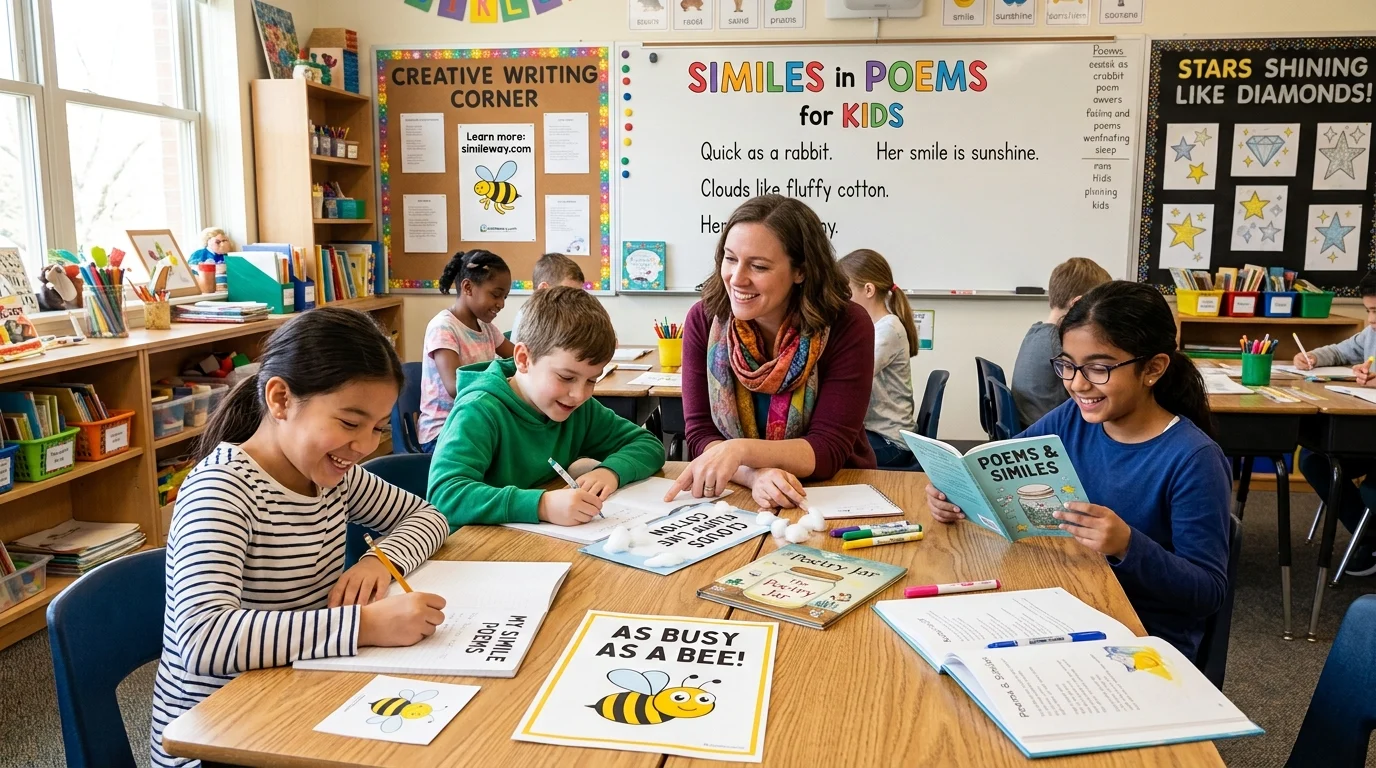
Similes are especially useful in poems for kids because children can use them to describe feelings, animals, nature, people, and everyday things in creative ways. For example, instead of saying, “The snow is white,” you might say, “The snow is as white as cotton.”
Let’s explore some easy examples of similes that kids can understand and use in their own poems. You might be surprised by how simple it is to create a great simile sentence.
What Is a Simile?
A simile is a figure of speech that compares two different things using “like” or “as.”
For example:
The moon is like a glowing lamp.
The moon is not really a lamp. The comparison helps us imagine how bright and round the moon looks.
Another example is:
She is as quiet as a mouse.
This means she is very quiet.
Similes make writing more colorful. They are common in poems, stories, songs, and creative writing.
20 Similes in Poems for Kids
1. As Bright as the Sun
Simile: The little star was as bright as the sun.
Meaning: Something is very bright.
What it conveys: This simile creates a strong picture of something shining with great brightness.
Example sentences:
- Her smile was as bright as the sun.
- The morning sky looked as bright as the sun.
2. As Busy as a Bee
Simile: The children were as busy as bees.
Meaning: Someone is very active and always doing something.
What it conveys: Bees are always flying around and working, so this comparison shows lots of activity.
Example sentences:
- My sister was as busy as a bee cleaning her room.
- The students were as busy as bees before the school show.
3. As Soft as a Cloud
Simile: The kitten was as soft as a cloud.
Meaning: Something feels very soft and gentle.
What it conveys: It helps readers imagine touching something smooth and fluffy.
Example sentences:
- The pillow felt as soft as a cloud.
- The kitten’s fur was as soft as a cloud.
4. As Fast as a Cheetah
Simile: The boy ran as fast as a cheetah.
Meaning: Someone runs very quickly.
What it conveys: A cheetah is famous for speed, so the comparison shows great quickness.
Example sentences:
- Sara ran as fast as a cheetah to catch the bus.
- The little dog moved as fast as a cheetah.
5. Like a Shining Star
Simile: Her eyes sparkled like shining stars.
Meaning: Her eyes looked bright and beautiful.
What it conveys: This comparison creates a magical image.
Example sentences:
- His eyes glittered like shining stars.
- The children looked like shining stars on the stage.
6. As Cold as Ice
Simile: The winter wind was as cold as ice.
Meaning: Something is extremely cold.
What it conveys: Ice gives readers a clear picture of freezing coldness.
Example sentences:
- The water was as cold as ice.
- The winter morning felt as cold as ice.
7. Like a Butterfly
Simile: The girl danced like a butterfly.
Meaning: She moved lightly and gracefully.
What it conveys: Butterflies move gently through the air, making this a beautiful comparison.
Example sentences:
- She moved like a butterfly across the stage.
- The dancer floated like a butterfly.
8. As Quiet as a Mouse
Simile: The baby was as quiet as a mouse.
Meaning: The baby made almost no sound.
What it conveys: This simile shows complete quietness.
Example sentences:
- Everyone became as quiet as a mouse during the story.
- The cat sat as quiet as a mouse.
9. Like a Roaring Lion
Simile: The wind sounded like a roaring lion.
Meaning: The wind made a loud and powerful sound.
What it conveys: It makes the sound of the wind seem strong and dramatic.
Example sentences:
- The storm howled like a roaring lion.
- The waves crashed like a roaring lion.
10. As Gentle as a Dove
Simile: The old woman was as gentle as a dove.
Meaning: She was kind, calm, and gentle.
What it conveys: The dove is often associated with peace and gentleness.
Example sentences:
- Her voice was as gentle as a dove.
- The teacher was as gentle as a dove with the young children.
11. Like a Silver Moon
Simile: The moon floated like a silver ball in the sky.
Meaning: The moon looked round and bright.
What it conveys: The comparison helps readers picture the moon shining against the dark sky.
Example sentences:
- The moon looked like a silver ball.
- A bright moon hung like a silver ball above the trees.
12. As Red as a Rose
Simile: The apple was as red as a rose.
Meaning: The apple had a deep red color.
What it conveys: The rose gives readers an easy color comparison.
Example sentences:
- Her cheeks were as red as roses.
- The little apple was as red as a rose.
13. Like a Rocket
Simile: The boy shot across the field like a rocket.
Meaning: He moved extremely quickly.
What it conveys: A rocket moves very fast, so the comparison makes the action exciting.
Example sentences:
- The runner moved like a rocket.
- The ball flew like a rocket across the playground.
14. As Hungry as a Wolf
Simile: After the game, I was as hungry as a wolf.
Meaning: I was extremely hungry.
What it conveys: The comparison makes the feeling of hunger stronger.
Example sentences:
- After school, I was as hungry as a wolf.
- The hikers were as hungry as wolves after their long walk.
15. Like a Dancing Flame
Simile: The candle flickered like a dancing flame.
Meaning: The light moved gently and quickly.
What it conveys: It creates a lively picture of moving light.
Example sentences:
- The fire moved like a dancing flame.
- The candle glowed like a dancing flame in the dark.
16. As Light as a Feather
Simile: The paper was as light as a feather.
Meaning: Something weighs very little.
What it conveys: A feather is very light, so it gives an easy comparison.
Example sentences:
- The leaf was as light as a feather.
- The tiny toy felt as light as a feather.
17. Like a Singing Bird
Simile: Her voice sounded like a singing bird.
Meaning: Her voice was sweet and pleasant.
What it conveys: A singing bird creates a happy and musical image.
Example sentences:
- She sang like a singing bird.
- The girl spoke like a singing bird.
18. As Strong as an Ox
Simile: The farmer was as strong as an ox.
Meaning: The farmer was very strong.
What it conveys: An ox is a strong animal, so this comparison shows great physical strength.
Example sentences:
- The athlete was as strong as an ox.
- My grandfather was as strong as an ox when he was young.
19. Like a Shy Rabbit
Simile: The little boy hid like a shy rabbit.
Meaning: He was nervous or afraid and wanted to hide.
What it conveys: The rabbit creates a cute picture of someone being timid.
Example sentences:
- The child stood like a shy rabbit behind his mother.
- She hid like a shy rabbit when the puppy barked.
20. As Happy as a Bird
Simile: The children were as happy as birds in spring.
Meaning: The children were very joyful.
What it conveys: Birds in spring suggest freedom, energy, and happiness.
Example sentences:
- The children were as happy as birds in spring.
- I felt as happy as a bird when school ended.
How to Use Similes in Writing
Using similes does not have to be difficult. Start by thinking about the thing you want to describe.
Ask yourself:
- What does it look like?
- What does it sound like?
- What does it feel like?
- What does it remind me of?
- What animal, object, or part of nature is similar to it?
For example, imagine you want to describe a very loud storm.
You could simply write:
The storm was loud.
Or you could make the sentence more interesting:
The storm sounded like a roaring lion.
The second sentence gives the reader a stronger mental picture.
When writing creative poems, try not to force a simile into every line. Choose comparisons that make your idea clearer or more exciting.
Practical Exercise: 10 Simile Questions
Try these questions before looking at the answers.
Questions
1. Identify the simile:
“The moon was like a silver coin.”
What two things are being compared?
2. Complete the simile:
“The baby was as quiet as a ______.”
3. Which sentence contains a simile?
A. The sun is hot.
B. The sun is like a golden ball.
C. The sun rises.
4. Complete the simile:
“The runner was as fast as a ______.”
5. What does this simile mean?
“Her voice was like a singing bird.”
6. Find the simile:
“The snow was as white as cotton.”
7. Complete the sentence:
“The pillow was as soft as a ______.”
8. What does “as busy as a bee” mean?
9. Create your own simile for a very cold day.
10. Create your own simile for a very happy child.
Answers and Explanations
1. Answer: The moon and a silver coin.
The writer compares the moon to a silver coin because both can look round and bright.
2. Answer: Mouse.
“Quiet as a mouse” is a common simile for someone who makes very little noise.
3. Answer: B. The sun is like a golden ball.
The word “like” shows that the sentence contains a comparison.
4. Answer: Cheetah.
A cheetah is known for being very fast.
5. Answer: Her voice was sweet, pleasant, or musical.
The writer compares her voice to a singing bird.
6. Answer: “The snow was as white as cotton.”
The phrase uses “as” to compare the color of snow with cotton.
7. Answer: Cloud.
“The pillow was as soft as a cloud” creates a picture of something soft and fluffy.
8. Answer: It means someone is very active or has many things to do.
Bees are always moving and working, so they make a useful comparison.
9. Sample answer: “The morning was as cold as ice.”
The comparison with ice shows that the morning was extremely cold.
10. Sample answer: “The child was as happy as a bird.”
The comparison shows that the child felt joyful and cheerful.
Remember, questions 9 and 10 can have many correct answers. The best similes are clear, creative, and easy to understand.
Conclusion
Similes make poems and creative writing more colorful and fun. They help readers picture an idea by comparing it with something familiar. A simple sentence can become much more interesting when you add a thoughtful comparison.
For example, “The stars were bright” is clear, but “The stars were like tiny diamonds” creates a stronger image.
When writing your own poems, look around you for ideas. Compare clouds to cotton, sounds to animals, or smiles to sunshine. There is no single right way to create a simile. The goal is to help your reader see, hear, or feel what you are describing.
So grab a pencil and start experimenting. Try writing five similes today. You may discover that creative writing is easier—and more fun—than you thought.

I am Ricardo Hunter, a passionate language enthusiast who explores similes, metaphors, and idioms. I create engaging content that helps readers understand creative expressions and improve their writing skills.