Similes and metaphors make writing more colorful, clear, and fun. Instead of simply saying, “The child was fast,” you might say, “The child was as fast as lightning.” This helps readers create a stronger picture in their minds.
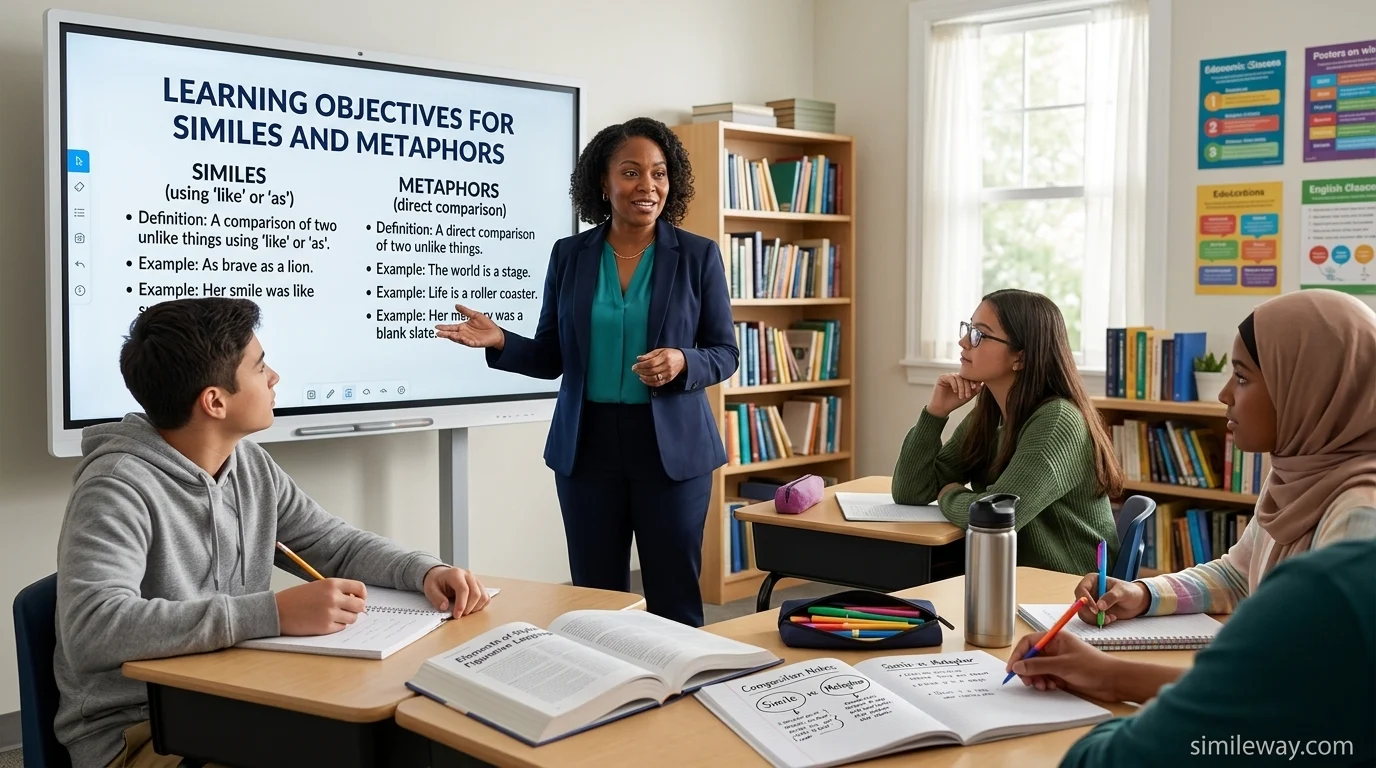
Learning objectives for similes and metaphors help students understand exactly what they should learn. For example, a student may learn how to identify a simile, explain its meaning, and create one in their own writing. These skills are useful in stories, poems, conversations, and creative writing.
In simple terms, a simile compares two different things using words such as like or as. A metaphor also compares two things, but it does not use like or as. Both can make simple ideas feel more interesting and imaginative.
Let’s explore clear learning objectives, examples of similes, simile sentences, and practical activities that can help beginners learn how to use similes in writing.
What Are the Learning Objectives for Similes and Metaphors?
After learning about similes and metaphors, students should be able to:
- Define a simile and a metaphor.
- Identify similes in sentences.
- Identify metaphors in sentences.
- Understand the meaning of similes.
- Explain what two things are being compared.
- Recognize the words like and as in similes.
- Tell the difference between similes and metaphors.
- Create original creative writing similes.
- Use simile sentences in stories and poems.
- Use metaphors to make writing more descriptive.
These learning objectives help students move from simply recognizing figurative language to using it with confidence.
What Is a Simile?
A simile is a figure of speech that compares two different things. It usually uses the words like or as.
For example:
Her smile was like sunshine.
The sentence compares a smile to sunshine. It does not mean her smile is actually the sun. It means her smile is warm, bright, or cheerful.
Another example is:
He was as busy as a bee.
This means he was very busy. Bees are known for constant activity, so the comparison helps explain the idea.
The meaning of similes is usually easy to understand when you think about the qualities of the two things being compared.
What Is a Metaphor?
A metaphor is also a comparison. However, unlike a simile, it does not use like or as.
For example:
The classroom was a zoo.
The classroom was not really a zoo. The sentence means it was noisy, busy, or out of control.
Here is another example:
Time is a thief.
Time cannot actually steal anything. This metaphor suggests that time passes quickly and takes moments away from us.
Simile vs. Metaphor
Here is a simple comparison:
| Feature | Simile | Metaphor |
|---|---|---|
| Makes a comparison | Yes | Yes |
| Uses like or as | Usually | No |
| Example | As cold as ice | Her heart was ice |
| Purpose | Creates a clear comparison | Makes a direct comparison |
| Common in creative writing | Yes | Yes |
In simple terms, a simile says something is like something else, while a metaphor says something is something else.
20 Examples of Similes
1. As busy as a bee
Meaning: Very busy.
Explanation: Bees are always moving and working, so this simile describes someone who has a lot to do.
Example sentences:
- My mother was as busy as a bee before the party.
- The students were as busy as bees during the school project.
2. As brave as a lion
Meaning: Very brave.
Explanation: Lions are often seen as symbols of courage and strength.
Example sentences:
- The firefighter was as brave as a lion.
- She felt as brave as a lion before going on stage.
3. As light as a feather
Meaning: Very light.
Explanation: A feather weighs very little, so the simile describes something easy to lift or carry.
Example sentences:
- The small bag was as light as a feather.
- After the rain stopped, the air felt as light as a feather.
4. As fast as lightning
Meaning: Extremely fast.
Explanation: Lightning appears almost instantly, making it a powerful comparison for speed.
Example sentences:
- The runner was as fast as lightning.
- He finished his homework as fast as lightning.
5. As quiet as a mouse
Meaning: Very quiet.
Explanation: Mice move softly and quietly, so the simile describes silence.
Example sentences:
- The baby was as quiet as a mouse.
- Everyone became as quiet as mice when the teacher entered.
6. As cold as ice
Meaning: Extremely cold.
Explanation: Ice is very cold, so this comparison makes the feeling easy to imagine.
Example sentences:
- The water was as cold as ice.
- His hands were as cold as ice in the winter.
7. As white as snow
Meaning: Very white.
Explanation: Fresh snow is bright and clean, making it a common image for whiteness.
Example sentences:
- Her dress was as white as snow.
- The walls looked as white as snow after being painted.
8. As strong as an ox
Meaning: Very strong.
Explanation: Oxen are powerful animals known for carrying and pulling heavy loads.
Example sentences:
- My uncle is as strong as an ox.
- The athlete became as strong as an ox after months of training.
9. As blind as a bat
Meaning: Unable to see well.
Explanation: This common expression is used when someone cannot see clearly.
Example sentences:
- Without my glasses, I am as blind as a bat.
- It was so dark that I felt as blind as a bat.
10. As sweet as honey
Meaning: Very sweet or kind.
Explanation: Honey is naturally sweet, so the comparison can describe food, words, or a person.
Example sentences:
- The mango was as sweet as honey.
- Her grandmother was as sweet as honey.
11. Like a fish out of water
Meaning: Feeling uncomfortable in a new situation.
Explanation: A fish needs water to survive, so without it, the fish feels out of place.
Example sentences:
- I felt like a fish out of water at the new school.
- He looked like a fish out of water at the fancy event.
12. Like a shining star
Meaning: Bright, special, or successful.
Explanation: Stars stand out in the night sky, so this simile can describe someone impressive.
Example sentences:
- She looked like a shining star on stage.
- His idea stood out like a shining star.
13. Like a rock
Meaning: Very strong, calm, or dependable.
Explanation: Rocks are solid and steady.
Example sentences:
- My father stood like a rock during the difficult time.
- She remained still like a rock.
14. As hungry as a wolf
Meaning: Very hungry.
Explanation: Wolves are often shown as eager hunters, so the comparison describes strong hunger.
Example sentences:
- I was as hungry as a wolf after the game.
- The children were as hungry as wolves after swimming.
15. As gentle as a lamb
Meaning: Very gentle and kind.
Explanation: Lambs are often seen as soft and peaceful animals.
Example sentences:
- The nurse was as gentle as a lamb.
- The little puppy was as gentle as a lamb.
16. Like a breath of fresh air
Meaning: Something refreshing or pleasant.
Explanation: Fresh air can make a person feel better and more comfortable.
Example sentences:
- Her positive attitude was like a breath of fresh air.
- The cool morning wind felt like a breath of fresh air.
17. As clear as crystal
Meaning: Very clear.
Explanation: Crystal can look clean and transparent.
Example sentences:
- The lake water was as clear as crystal.
- Her explanation was as clear as crystal.
18. As free as a bird
Meaning: Completely free.
Explanation: Birds can fly through the sky, so they often represent freedom.
Example sentences:
- After finishing school, he felt as free as a bird.
- The child ran through the field as free as a bird.
19. Like a ray of sunshine
Meaning: Someone or something that brings happiness.
Explanation: Sunshine often feels warm and cheerful.
Example sentences:
- Her smile was like a ray of sunshine.
- The good news was like a ray of sunshine.
20. As slippery as an eel
Meaning: Hard to hold, catch, or understand.
Explanation: Eels have smooth bodies and can be difficult to hold.
Example sentences:
- The wet fish was as slippery as an eel.
- The question was as slippery as an eel and hard to answer.
How to Use Similes in Writing
Learning how to use similes in writing is simple. First, think about what you want to describe.
For example, imagine you want to describe someone who is very happy.
You might say:
She was as happy as a child on a holiday.
Next, think about the quality you want to show. Do you want to show speed, beauty, fear, strength, or happiness?
Then choose something that has the same quality.
For example:
- Fast → lightning
- Strong → an ox
- Quiet → a mouse
- Cold → ice
- Bright → the sun
You might say:
The car moved like lightning.
Good creative writing similes help readers see, hear, or feel what you are describing.
How to Identify Similes and Metaphors
When you read a sentence, ask yourself a few simple questions:
- Is the sentence comparing two things?
- Does it use like or as?
- Is the comparison meant to be imaginative?
- What quality is being compared?
For example:
The baby slept like a log.
This is a simile because it uses like.
Now look at this:
The baby was a sleeping angel.
This is a metaphor because it directly compares the baby to an angel.
Practical Exercise: 10 Questions About Similes and Metaphors
1. Identify the simile:
The boy was as fast as lightning.
Answer: As fast as lightning.
Explanation: The sentence compares the boy’s speed to lightning.
2. Complete the simile:
As busy as a ________.
Answer: Bee.
Explanation: Bees are known for constant activity.
3. Is this a simile or a metaphor?
Her voice was music to my ears.
Answer: Metaphor.
Explanation: The sentence directly compares her voice to music.
4. Complete the sentence:
The snow was as white as ________.
Answer: A common answer is milk or a cloud.
Explanation: Both describe something very white.
5. Identify the comparison:
He fought like a lion.
Answer: He is compared to a lion.
Explanation: The comparison shows bravery and courage.
6. Is this sentence a simile?
The classroom was a zoo.
Answer: No. It is a metaphor.
Explanation: It compares the classroom directly to a zoo.
7. Complete the simile:
As light as a ________.
Answer: Feather.
Explanation: Feathers are very light.
8. What does this simile mean?
She was as quiet as a mouse.
Answer: She was very quiet.
Explanation: A mouse moves softly and quietly.
9. Create your own simile for happiness.
Sample answer: I was as happy as a bird flying in the sky.
Explanation: This simile connects happiness with freedom.
10. Change this sentence into a simile:
The child ran very fast.
Answer: The child ran as fast as lightning.
Explanation: The simile makes the sentence more descriptive and exciting.
Classroom Activities for Learning Similes and Metaphors
Teachers and students can use simple activities to practice these skills.
Simile Matching Game
Write the first half of several similes on one set of cards. Write the endings on another set.
For example:
- As busy as…
- As cold as…
- As light as…
Students match them with:
- A bee
- Ice
- A feather
This activity helps students remember common examples of similes.
Complete the Simile
Give students unfinished simile sentences.
For example:
The baby was as cute as a ________.
Students can create their own answers, such as:
- Puppy
- Kitten
- Button
This encourages creativity.
Simile Hunt
Ask students to look for examples of similes in books, poems, songs, or stories. They can write down each example and explain its meaning.
Picture to Simile Activity
Show students a picture and ask them to create a simile.
For example, show a picture of a fast car.
A student might say:
The car was as fast as lightning.
This activity connects imagination with descriptive writing.
Why Are Similes and Metaphors Important?
Similes and metaphors make language more powerful. They help readers understand ideas by connecting them to familiar things.
Instead of saying:
The night was dark.
You might say:
The night was as dark as ink.
The second sentence creates a stronger image.
Similes can also help students:
- Improve creative writing.
- Build a stronger vocabulary.
- Understand figurative language.
- Make stories more interesting.
- Express feelings clearly.
- Develop imagination.
For example, when a writer says, “Her anger was like a storm,” readers can imagine something powerful and intense.
Final Thoughts
Learning objectives for similes and metaphors give students a clear path for understanding figurative language. By learning to identify comparisons, explain their meaning, and create original examples, students can become more confident writers.
The best way to learn is through practice. Read examples of similes, notice how they work, and then try creating your own. You might say something is as bright as the sun or as quiet as falling snow. There are endless possibilities.
So, have fun with words and let your imagination guide you. The more creative writing similes you create, the easier it becomes to make your writing colorful, clear, and memorable.

I’m Chloe Thomas, a language enthusiast passionate about similes, metaphors, and idioms. I enjoy creating simple, engaging content that helps readers understand expressions, improve communication, and appreciate the beauty of language.